We’ve looked at cheap and cheerful home-made DIY compost toilets; waterless, sawdust toilets which are basically a bucket you need to empty yourself every few days. These systems work, speeding up the action and fertility of a conventional compost heap and providing an extremely environmentally friendly way of dealing with human waste. But, being of a ‘back to basics’ nature they really are not for everyone.
If you prefer a less hands on approach to the waterless toilet you can buy self contained compost toilets instead. These self contained systems are a very glamorous version of the bucket compost loo. Whereas a sawdust toilet merely stores your poo until it is added to a compost heap to break down, these self contained waterless toilets keep hold of the waste till it has decomposed completely. You do need to empty them, but rarely, and then you only ever remove a small amount of completely decomposed hummus which basically resembles a small tray of soil. A job even the most squeamish should be able to manage.
How Self Contained Compost Toilets Work
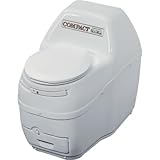

Lifting the lid on a self contained toilet should hold no surprises. Baffles usually hide the addition of the previous occupant, perhaps the biggest ‘put off’ for most people when confronted with a basic sawdust toilet. My particular favorite model actually has sensors in the seat which open the baffles when it feels the weight of a new occupant. That’s a much more sci-fi composting toilet than ours!
The addition of a chimney stack allows air to flow into the compost drum. This additional oxygen is crucial for the waste to compost aerobically.
The vent stack also allows water to evaporate from the human waste. This reduction of the liquid content completely changes the process. Evaporation reduces the bulk of waste material by up to 90%. So in simple terms the drum will take ten times as long to fill as my rustic sawdust toilet.
With most commercial self contained systems there is a fan incorporated into the vent stack to improve air circulation, removal of odours and evaporation. These fans can be run from the mains or battery power. If you’re off grid like us, double check the power consumption of the fan as they vary widely. You should be able to find one which is low enough wattage to run on the most basic of solar set ups. If you can put the vent pipe in with no bends, and a good roof clearance there are several models which will work well without a fan in operation.
At the base of the compost toilet is a reservoir for the water content of the waste. This then evaporates via the vent stack. However, the less power the fan uses the more chance there is of liquid building up and you may find you actually need to install an emergency overflow to cope with this, particularly if you use your self contained composting toilet on a continual basis.
The general idea with these self contained composting toilets is that the waste drops into a drum which you intermittently rotate. This keeps everything loose and ready to break down. Underneath the drum is a tray which collects the resulting hummus. You leave this hummus for at least a month before emptying. So you never go near any non-decomposed waste at all.
These self contained systems obviously have a limited capacity so it is crucial that the correct sized system is purchased. The cheapest models are really only suitable for occasional use. All sizes tend to come with the proviso that an overflow is fitted if there are likely to be significant numbers of extra people using the system. So for parties or weekend gatherings it might make sense to offer your male guests the use of a straw-bale in the yard for urinating.
Self contained compost toilets are odourless and very low maintenance. In homes they will need to be partially emptied every few months. Sawdust toilets on the other hand need to be completely emptied of fresh human waste every few days.
But, they are not as versatile as a more basic system. You really need to install the correct model for the volume of use you expect in the long term. Having to connect an overflow for excess liquid to run off might well be an installation process too far, when the whole concept is to have a self contained unit which can be sited anywhere.
For a more self sufficient future
What is your opinion on using human waste for eatable crops?
I don’t think that is would be safe but I have heard some people saying that it is ok
Well sludge is used all over US farms to fertilise crops and that contains heavy metals, chemical pollutants and human poo so I think pure composted humanure is pretty safe. Having eaten food fertilised with it for years I’m not complaining! The key is that composted poo is basically soil, all the nasty possible dangerous stuff is long gone, and if you’re happy for crops grown in soil there should be nothing to worry about.
I’m not sure about human sludge and food crops in the US — I know my uncle participated in a feasibility study many years ago where human sludge was spread on his pasture land, but he was specifically told not to put it on food crops directly.
In your subsequent post you mention adding an additional step of re-composting “night soil” to finish degrading any specifically human, specifically human-pathogenic microbes that might linger in human sludge… this sounds wise to me.
Be very careful when choosing a manufactured compost toilet. Of course their manufacturers will all claim that they work beautifully and the simplicity of the composting process in nature would make you think that the claims of these toilet advertisers are possible. There are however a large amount of negative reviews of these self contained units and I have had a long struggle with an Envirolet model myself. I have published the story of my experience here to help get the truth out there: http://practicallyoffthegrid.com/2010/03/envirolet-composting-toilet-fit-for-the-pit/
My advice is to stick with the simple diy low tech designs such as the sawdust toilet. Composting is one thing nature has perfected so why waste your cash on some faulty man made scheme.
Jared,
That is a lot of money for a loo! I guess it is worth spending the time to investigate these properly. Read all the reviews you can and pick the best. Although we do fine with our simple composting loo with just sawdust, but manual emptying is not for everyone.
i need more information on the Chipper Solar waterless toilet
I applaud all the efforts by Bill gates and others to come up with a better toilet, but in my humble opinion, they are seeking high tech solutions to a low tech problem. A tank of human wast, urine and solids together, is raw sewage and a very serious health risk. However, if you separate the urine from the solids, it’s much easier to deal with. Urine is sterile and not a health risk. It can be safely drained into a small pit, or mixed with water and sprayed on plants as fertilizer. Solids are the toxic part. But if there is no urine added, they dry out very rapidly and shrink dramatically. Then it is very, very easy to safely and quickly compost this material.
Even a urine diverting seat will reduce odor in a typical outhouse by about 90%.
I have a blog on the subject here: urine diverting toilets
We installed a SunMar composting toilet about a month ago in a new cabin. 3 guys use the cabin as a start-up business premises. It has been working perfectly – no smells or spillage.
We use wood shavings and dried grass clippings and will be experimenting with coconut coir in the near future.
The guys are quite geeky and into high-tech and have no complaints, despite initial reservations.